Replication Sites
The RHE-MEDiation project invited its Associated Regions to showcase the feasibility, replicability, and scalability of its solutions. Through the Open Call, selected projects developed and implemented innovative strategies to prevent, monitor, and remediate chemical pollution, contributing to the restoration and protection of the Mediterranean Sea.
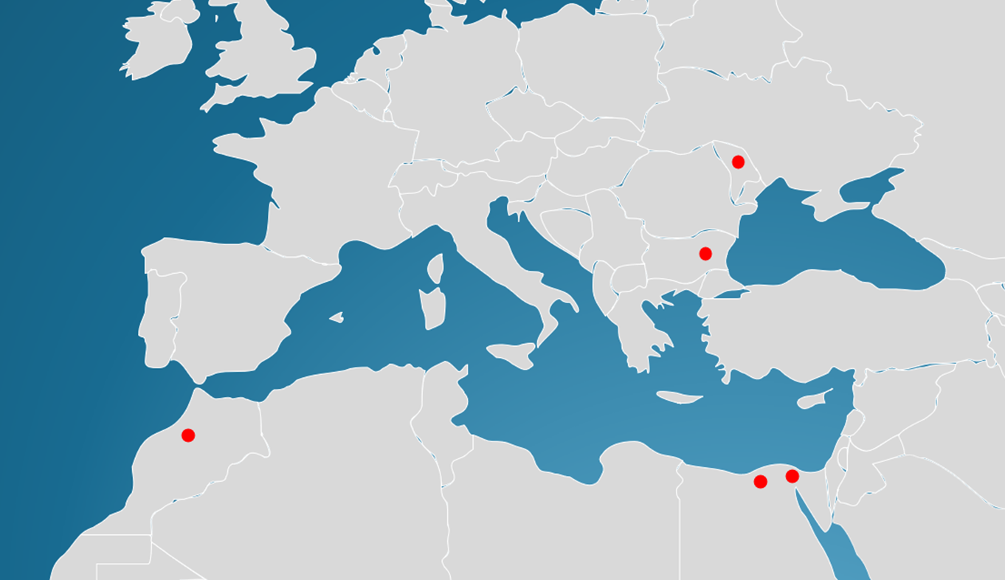
 GISmart Rhemediation - AGCC Agency for Geodesy, Cartography and Cadastre, Moldova
Project Description and Objectives:
The Ișnovăț River sub basin in Moldova is severely impacted by nutrient loading, agricultural runoff, and legacy pollution, resulting in degraded water quality and ecosystem health. The GISmart RHE-MEDiation project evaluates the feasibility of deploying the GREEN DUNE® microalgae photobioreactor to remove nutrients, heavy metals, pesticides, and priority pollutants, whilst also integrating spatial data through the SIGSNL (State Geographic Informational System at the Local Level) system. This combined bio remediation and geospatial approach aims to deliver sustainable, low maintenance water quality improvements aligned with EU water directives. Implementation is led by AGCC (Agency for Geodesy, Cartography and Cadastre) with scientific and institutional partners (such as the local Institute of Zoology) to ensure relevance and governance integration. Spatial analyses will ensure optimal installation sites, and capacity building activities will strengthen local expertise. By project end, measurable improvements in water quality will be formulated into a Road Map (e.g. reduced concentrations of nitrates, phosphates, and priority pollutants) feasible in the Ișnovăț sub-basin, with the aim of demonstrating clear environmental impact.
The objectives of the Project are:
- Determine the technical, environmental, and economic viability of deploying the GREEN DUNE® photobioreactor in the Ișnovăț sub basin, supported by field data and stakeholder inputs.
- Operationalize and enhance the Local Geographic Information Systems, enabling systematic use of geospatial datasets for local environmental decision making.
- A stakeholder validated Roadmap will be developed and will outline technical specifications, policy guidance, and financing strategies for national replication of RHE MEDiation solutions.
- The project will reinforce cross institutional capacity for water quality monitoring through staff training, multi stakeholder workshops, and coordinated governance meetings.
 Clean Port Said - Port Said Governorate (Institute of National Planning), Egypt
Project Description and Objectives:
The project aims to design a strategic environmental remediation framework for Port Said (Egypt), by evaluating the feasibility and replicability of RHE-MEDiation technologies to address significant pollution challenges in the region (semi-enclosed coastal ecosystem impacted by industrial pollution). A targeted sampling campaign and accredited laboratory analyses aims to establish the chemical baseline, characterize contamination hotspots, and supply the technical evidence required for future remediation planning. These data will support a comprehensive feasibility study evaluating technological, infrastructural, and regulatory compatibility with regards of Port Said’s coastal system. The Institute of National Planning (NIP), formally mandated by local authorities, will coordinate implementation, institutional governance, and technical assessments, involving also external experts, if needed. Expected outputs include a validated contamination dataset, hotspot mapping, and an operational roadmap for potential deployment of RHE MEDiation inspired solutions, contributing to improved environmental management, reduced chemical pollution, and alignment with EU approaches to sustainable coastal protection.
The objectives of the Project are:
- Conduct targeted sampling and accredited laboratory analyses to map and characterise key chemical pollution hotspots in Port Said’s coastal and drainage systems, establishing an evidence base for remediation planning.
- Assess the feasibility of integrating RHE MEDiation’s microalgae based remediation technology by evaluating its compatibility with local environmental conditions, infrastructure, and regulatory frameworks. While also engaging stakeholders through a platform to co develop remediation pathways.
- Develop a replication and scale up roadmap supported by analytical findings, stakeholder input, and strengthened institutional capacity, ensuring knowledge transfer and positioning Port Said as a national reference for future nature based chemical pollution mitigation strategies.
 REMEDTAR - Municipality of Tangier, Morocco
Project Description and Objectives:
The Project, located in Tangier (Morocco), aims to target significant chemical contamination affecting a semi-confined coastal zone impacted by industrial discharges and urban runoff, currently lacking real-time monitoring and coordinated pollution control. The Project aims to address historic and ongoing contamination, limited institutional monitoring capacity, and the absence of coordinated remediation strategies. A water quality monitoring system tailored to Moroccan hydrological and infrastructural conditions will be established, enabling continuous tracking of priority pollutants and supporting timely interventions. A central outcome is the replication and validation of the RHE MEDiation models previously tested. The project will also develop a stakeholder supported roadmap defining intervention priorities, governance roles, and financing pathways. Through training, co creation, and public engagement, the Project aims to strengthen local capacity and contribute to national efforts to reduce chemical pollution, aligning with the EU Mission “Restore our Ocean and Waters”.
The objectives of the Project are:
- Monitor priority pollutants such as lead, cadmium, and PFAS.
- Adapt and validate the RHE-MEDiation setups for local industrial, infrastructural, and hydrological conditions in Morocco.
- Engage stakeholders through co-creation activities, sessions, and technical consultations to ensure institutional alignment and uptake.
- Develop a strategic roadmap for upscaling, including policy integration, funding scenarios, and replication in sites.
 (SINAQUA): North Sinai Governorate (Ministry of Water Resources and Irrigation), Egypt
Project Description and Objectives:
The SINAQUA Project aims to demonstrate the feasibility of microalgae based bioremediation for treating high load agricultural drainage water discharged from the Balooza Drainage Water Station (BDWS) into the Suez Canal (Egypt); being this a major pollution hotspot affecting the Mediterranean Sea. In fact, the BDWS releases ~388,800 m³/day of untreated effluent containing pesticides, PFAS, heavy metals, nutrients, and high salinity. The Project will be implemented by the Ministry of Water Resources and Irrigation with scientific support from NIOF (National Institute of Oceanography and Fisheries). The Project will follow three stages: baseline characterization and stakeholder engagement; feasibility assessment and monitoring protocol design using predictive tools; and environmental benefit simulation with a national upscaling roadmap. The Project will address the absence of treatment infrastructure and significant diffuse agricultural pollution, and will integrate scientific validation, field engineering, and institutional coordination to deliver a replicable model for sustainable water remediation in Egypt and the wider Mediterranean region.
The objectives of the Project are:
- Assess the pollution profile and environmental risks associated with untreated drainage from BDWS to the Suez Canal and Mediterranean Sea (with a focus on key contaminants)
- Determine the feasibility of applying a microalgae-based bioremediation system, specifically GREEN DUNE® photobioreactors, under the specific physicochemical conditions (also supported by theoretical pollutant prediction tools).
- Develop a site-specific environmental monitoring protocol that includes key priority pollutants and establish baseline and performance benchmarks for future pilot interventions.
- Project the expected environmental impact of deploying the RHE-MEDiation solution (GREEN DUNE® photobioreactors) at BDWS using scientifically validated forecasting tools, and deliver a regulatory and technical roadmap for replication and upscaling across Egypt’s national drainage network.
 SCeNiC - Municipality of Sozopol, Bulgaria
Project Description and Objectives:
The SCeNiC Project will conduct a theoretical replication of RHE-MEDiation technologies to address persistent chemical pollution in coastal seawater and inland semi-confined areas. The core intervention will be performed at the Port of St. Nicolas in Chernomorets (Sozopol Municipality, South-Eastern Bulgaria), one of Bulgaria’s largest fishery ports and environmental hotspots. The Project will perform a feasibility study and develop a context specific replication strategy. Then, a roadmap for potential future implementation will be developed and a Living Lab (to support continuous stakeholder engagement) will be established. The project will engage local and regional authorities for strategic alignment, port administrators for operational insights and scientific institutions for the technical evaluations. The key challenges include: managing diverse stakeholders’ interests and tailoring technological solutions to local conditions. Ultimately, the project aims to validate the effectiveness of RHE-MEDiation technologies, enhance local capacities for environmental management and foster durable partnership among institutional, scientific and technological actors.
The objectives of the Project are:
- Complete a Feasibility Assessment of RHE-MEDiation technologies at the Port of St. Nicolas, providing a theoretical evaluation of their applicability and regulatory compatibility.
- Develop a replication strategy and roadmap, outlining also governance structures and roles of stakeholders.
- Establish a functioning Living Lab to enable continuous stakeholder involvement, co-creating, and collaborative innovation.
- Host and document the stakeholder engagement, aimed at validating and formally endorsing the replication strategy and roadmap.